

You are looking for construction project tracking software. But are you looking for the right type of tool?
You are looking for construction project tracking software.
After a few searches, you quickly discover dozens of solutions. Some promise to manage everything: estimates, invoices, scheduling, human resources, purchasing, accounting, document management, project tracking, CRM, document repositories and more. Others focus more specifically on field operations.
With so many options available, one question comes up again and again: how do you choose the solution that best fits your business?
The answer is not only found in the number of features offered.
The real challenge is to choose a tool that meets your current needs, that your teams will actually adopt, and that naturally fits into your company's organization.
In other words, the topic is not just finding the best software. It is understanding the place that software should occupy in your digital architecture.
The best software is not the one that does everything. It is the one that perfectly answers the need it was designed for.
Not every construction company has the same needs
The construction sector is made up of a very large number of companies, with a strong concentration of small and medium-sized businesses. Industry organizations regularly highlight how important small companies and craft businesses are in the structure of the sector.
This reality matters because a company with three people does not have the same needs as a fifty-person business or a group operating across several regions.
A craft business will often look first for a way to communicate better with clients, share photos, track project progress and find documents quickly.
A more structured company will also need to manage human resources, purchasing, inventory, timesheets, estimates, invoices, financial indicators and equipment resources.
The question is therefore not only: which software should we choose?
The real question is: what tool does your company actually need at its current level of maturity?
Sources: FFB — Le bâtiment en chiffres, CAPEB.
The most common mistake: looking for software that does everything
When a company starts its digital transformation, it often looks for software capable of covering every need.
The idea sounds attractive: one tool for accounting, HR, estimates, invoices, purchasing, documents, communication and project tracking.
In practice, this approach quickly reaches its limits.
The more business areas a tool tries to cover, the more complex it becomes to use. Interfaces multiply, configuration becomes heavier and onboarding requires more training.
The risk is no longer that the software lacks features.
The risk is that field teams slowly stop using it and return to simpler tools such as phone calls, SMS, email or WhatsApp.
An all-in-one tool can be highly relevant in some contexts. But it must match the size, resources and real organization of the company.
ERP and construction project tracking software: two complementary tools
When discussing digitalization in construction, one confusion often appears: many companies look for software capable of managing everything.
Yet not every solution has the same purpose.
An ERP, or Enterprise Resource Planning system, centralizes business management data: accounting, finance, purchasing, invoicing, human resources, inventory and equipment resources.
Construction project tracking software, on the other hand, supports teams in the operational execution of projects. It improves communication, information sharing, progress tracking and daily coordination between stakeholders.
These two approaches are not opposed. They are complementary.
| ERP | Construction project tracking software |
|---|---|
| Accounting and finance | Project progress |
| Estimates, invoicing and purchasing | Communication between stakeholders |
| Human resources and payroll | Project photos and documents |
| Inventory and equipment resources | Meetings and minutes |
| Timesheets and management data | Operational planning and field decisions |
| Overall business management | Daily collaboration around projects |
In a well-structured company, it is usually better to let each tool play its role.
The ERP centralizes business management data. The project tracking tool supports operational project management and collaboration between stakeholders.
Digital tools should be thought of as an architecture, not as isolated software
This is probably the most common mistake: looking for one tool that can solve every problem.
In reality, companies that succeed in their digital transformation think differently. They gradually build an architecture where each tool has a clearly defined mission.
In most companies, Microsoft Teams coexists with an ERP. Each one answers a different need: one supports collaboration, the other centralizes business management.
The construction sector follows the same logic.
A construction project is not just a team. It is an ecosystem of stakeholders who need to share the same level of information in order to make the right decisions at the right time.
A successful digital transformation is not about finding software that does everything. It is about making several tools work intelligently together.
ERP
Internal business management
PIYA
Operational and relationship platform for the jobsite
A digital architecture evolves with your company
The needs of an independent craft business are not the same as those of a fifty-person company.
As a company grows, its information system naturally evolves.
| Company size | Recommended architecture |
|---|---|
| Independent craft business | Project tracking application to centralize exchanges, documents and progress. |
| Small business | Project tracking application + simple administrative tools. |
| SME | ERP or internal management tool + project tracking software for field operations. |
| Mid-sized company / large group | ERP + specialized business software + project tracking application connected to project stakeholders. |
There is therefore no universal solution.
A relevant architecture is first and foremost one that is adapted to the company's maturity, resources, teams and projects.
Your ERP structures your business. PIYA connects jobsite stakeholders.
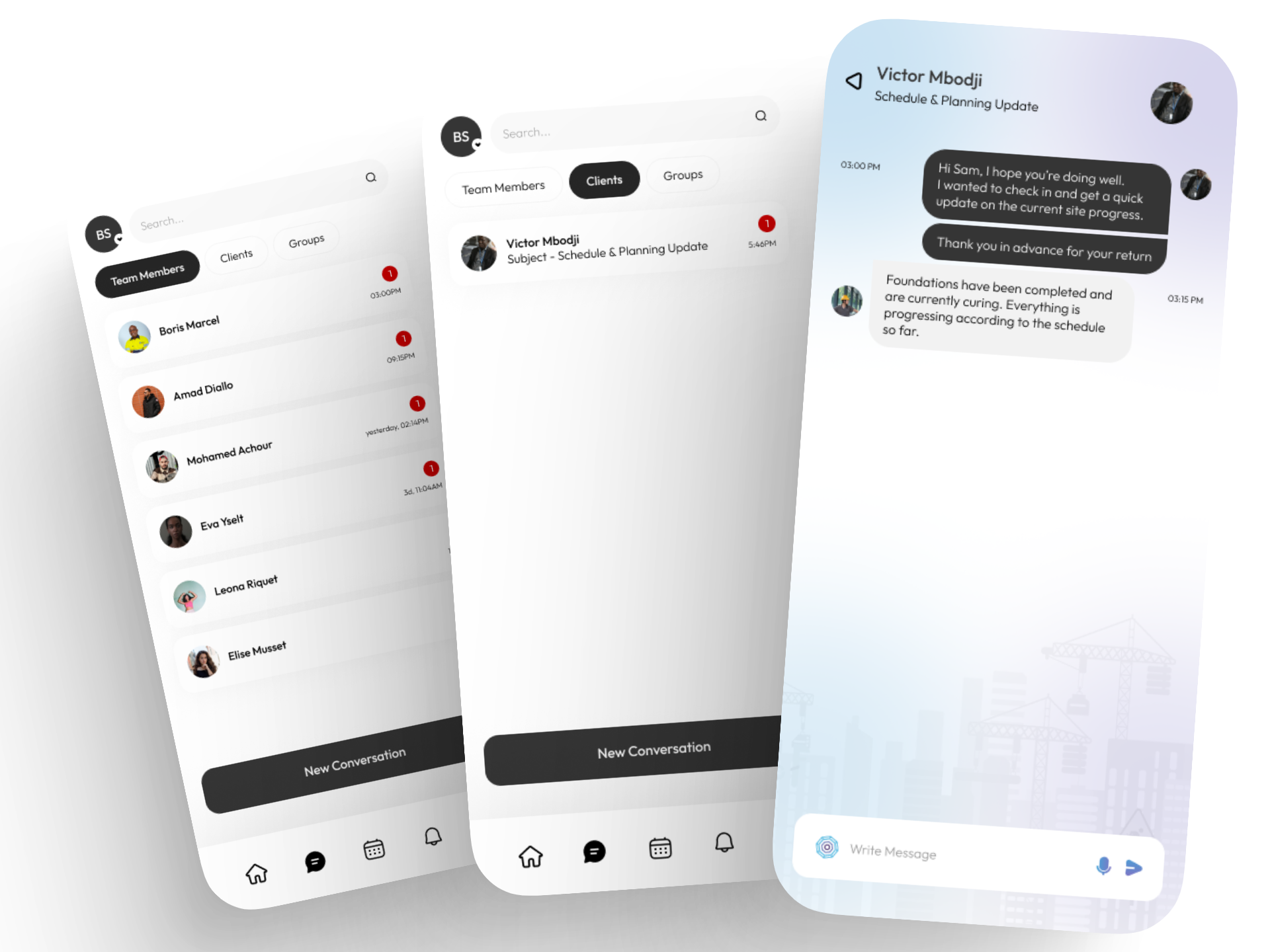
Teams, clients, subcontractors, designers, suppliers: PIYA centralizes operational exchanges and information around each project.
Why some software is abandoned by field teams
When a digital transformation project fails, the reason is not always technical.
It is often human.
Some software mainly answers the needs of administrative or management functions, while field teams expect simple, fast and mobile-friendly tools.
A project manager, team leader or contractor wants to open a phone, find a document, share a photo, check progress, create a meeting, inform a client or send information to a subcontractor.
If they have to navigate several screens or fill out complex forms to complete these simple actions, adoption quickly becomes difficult.
Teams then naturally return to the tools they already use every day: phone calls, SMS, WhatsApp or email.
The best software is therefore the one teams actually use.
And that depends first on simplicity, mobility and alignment with real field habits.
How to choose the right construction project tracking software
Before comparing long lists of features, start by clarifying the role the software should play in your company.
A good construction project tracking tool should help you answer a few simple questions.
- Is it truly adapted to the size of my business?
- Can my teams use it easily in the field?
- Can it centralize exchanges, documents, photos, meetings and decisions?
- Does it make collaboration easier with clients and external stakeholders?
- Is it simple enough to be adopted quickly?
- Can it complement my existing tools without creating unnecessary complexity?
- Can it support the growth of my business?
The right choice therefore does not only depend on the number of modules available.
It depends above all on the tool's ability to fit naturally into your organization and be used by the people who actually move projects forward.
Where does PIYA fit?
PIYA is not designed to replace your ERP.
If your company already has an internal management tool, PIYA strengthens it by becoming the operational and relationship platform for the jobsite.
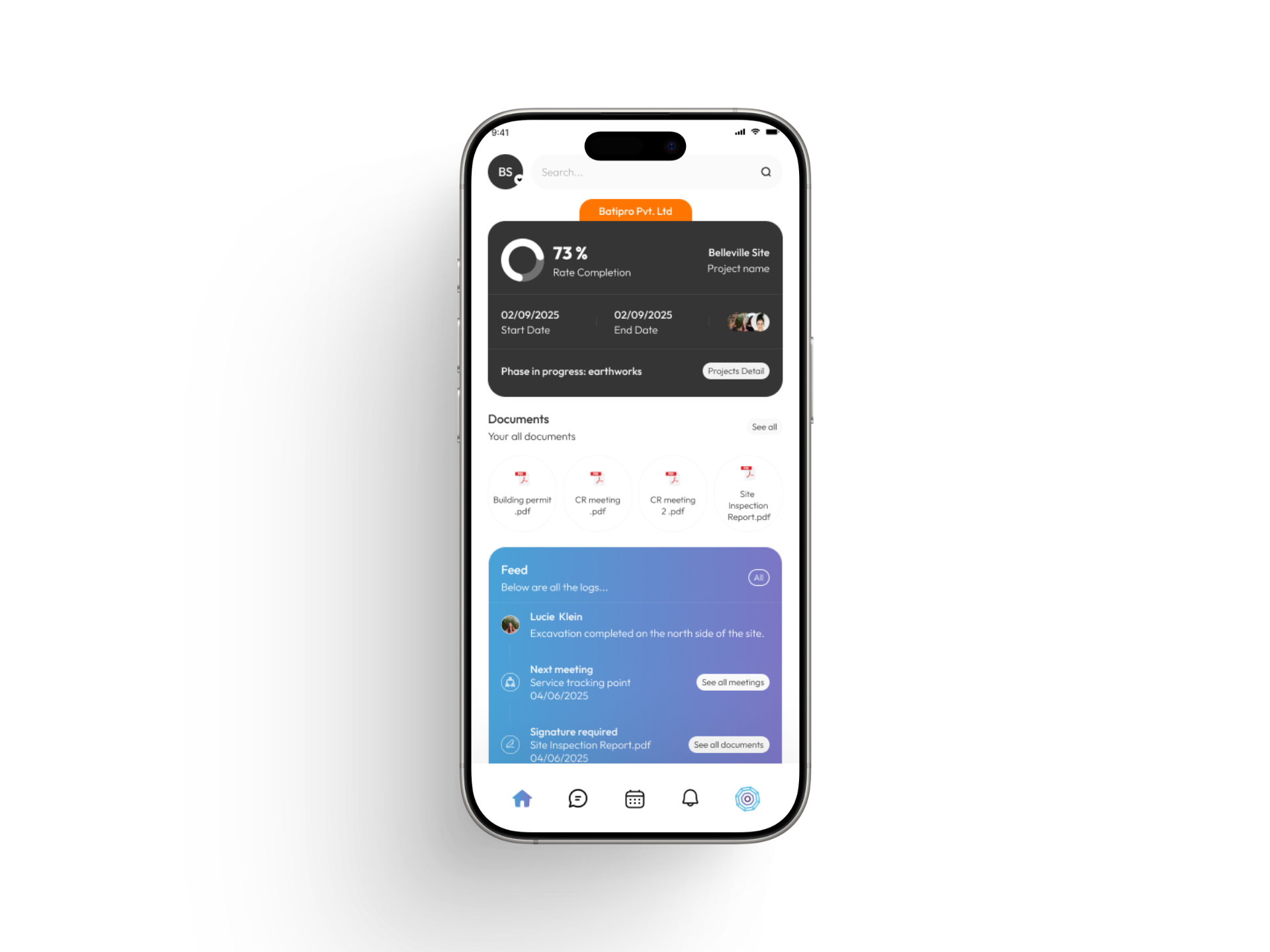
PIYA centralizes exchanges, documents, photos, meetings, decisions and progress in order to connect teams, clients, subcontractors, owners, designers and suppliers around shared information.
For an independent contractor or small business, PIYA can also be the first simple foundation for tracking projects, communicating better with clients and structuring essential information.
In both cases, the goal remains the same: make construction projects clearer, more collaborative and easier to manage day to day.
Track your projects with an app designed for the field
PIYA helps construction professionals centralize progress, documents, photos, meetings and exchanges around each project.
Conclusion
Choosing construction project tracking software is not about selecting the solution that promises to do everything.
It is about understanding your company's needs, your organization's level of maturity and the role each tool should play in your digital environment.
Companies that succeed in their digital transformation are not the ones that accumulate the most software.
They are the ones that build an architecture where each solution has a clear mission.
In that architecture, the ERP centralizes business management data.
And construction project tracking software like PIYA connects the people who actually move projects forward.
FAQ
Frequently Asked Questions
How do you choose construction project tracking software?
Choose software that fits your company size, is simple to use in the field, and can centralize exchanges, documents, photos, meetings and project progress.
What is the difference between an ERP and construction project tracking software?
An ERP centralizes internal business management data. Construction project tracking software supports operational project management and collaboration between stakeholders.
Can construction project tracking software replace an ERP?
No. The two tools are complementary. The ERP manages internal business data, while construction tracking software supports teams in the field.
Why do field teams abandon some construction software?
Because these tools can be too complex, not mobile-friendly, or too far from the daily habits of project managers, contractors and field teams.
Is PIYA an ERP?
No. PIYA is a construction project tracking app that centralizes exchanges, documents, photos, meetings and progress to connect project stakeholders.