

The meeting is over. But what happens next?
The meeting has just ended.
Everyone seemed aligned. Decisions were made, the discussion felt productive and each participant left with the impression that the project could now move forward smoothly.
Yet one week later, some of the same topics are already back on the table.
An intervention has not been completed. A supplier is still waiting for approval. A subcontractor did not receive the latest instructions. And no one is really sure whether those actions were clearly assigned or simply mentioned during the meeting.
In construction, site meetings are essential. They help coordinate stakeholders, solve problems encountered on site and make decisions that directly influence project progress.
But a meeting alone does not improve a project.
The decisions that follow are what create value.
The problem is usually not the meeting. The problem is what happens after it.
A construction meeting only creates value if it leads to action
A construction meeting is not just a moment to exchange information.
It should help coordinate stakeholders, resolve blockers, arbitrate technical decisions, plan upcoming work and secure proper execution on site.
In other words, a meeting should always produce concrete decisions.
When no action is clearly defined, when no owner is identified or when no deadline is set, discussions remain theoretical and the project often continues as before.
A good meeting is not measured by the time spent around the table.
It is measured by its ability to move the project forward.
Why do the same topics keep coming back?
Most construction professionals have experienced this situation.
A topic is discussed during a meeting. Everyone seems to agree. Then, a few days later, it comes back in exactly the same way.
Why?
Because the decision was never truly turned into an action.
The causes are often the same:
- decisions remain in a notebook;
- meeting minutes are sent several days later;
- each participant leaves with their own interpretation;
- responsibilities are not clearly assigned;
- no deadline has been defined.
As the project progresses and the number of stakeholders increases, these small ambiguities can create delays, misunderstandings and tension between the different parties involved.
An untracked decision is a decision that is often forgotten.
Coordination issues cost more than most teams realize
Coordination is widely recognized as one of the key factors behind successful construction projects.
The Project Management Institute (PMI) highlights that clear governance, structured communication and rigorous decision follow-up can significantly improve project performance.
The Lean Construction Institute also emphasizes the importance of collaborative planning and systematic follow-up on commitments made by teams to reduce delays and rework.
In Europe, organizations such as the Association for Project Management and the Chartered Institute of Building regularly underline the importance of preparation, accountability and clear communication in project delivery.
These recommendations are not only relevant for large contractors.
Whether a project involves five people or fifty, a forgotten decision often produces the same consequences: delayed work, contradictory information and time lost clarifying something that had already been discussed.
Sources: Project Management Institute (PMI), Lean Construction Institute, Association for Project Management, CIOB.
Centralize construction meeting decisions
Every decision made during a meeting should be easy to find several weeks later.
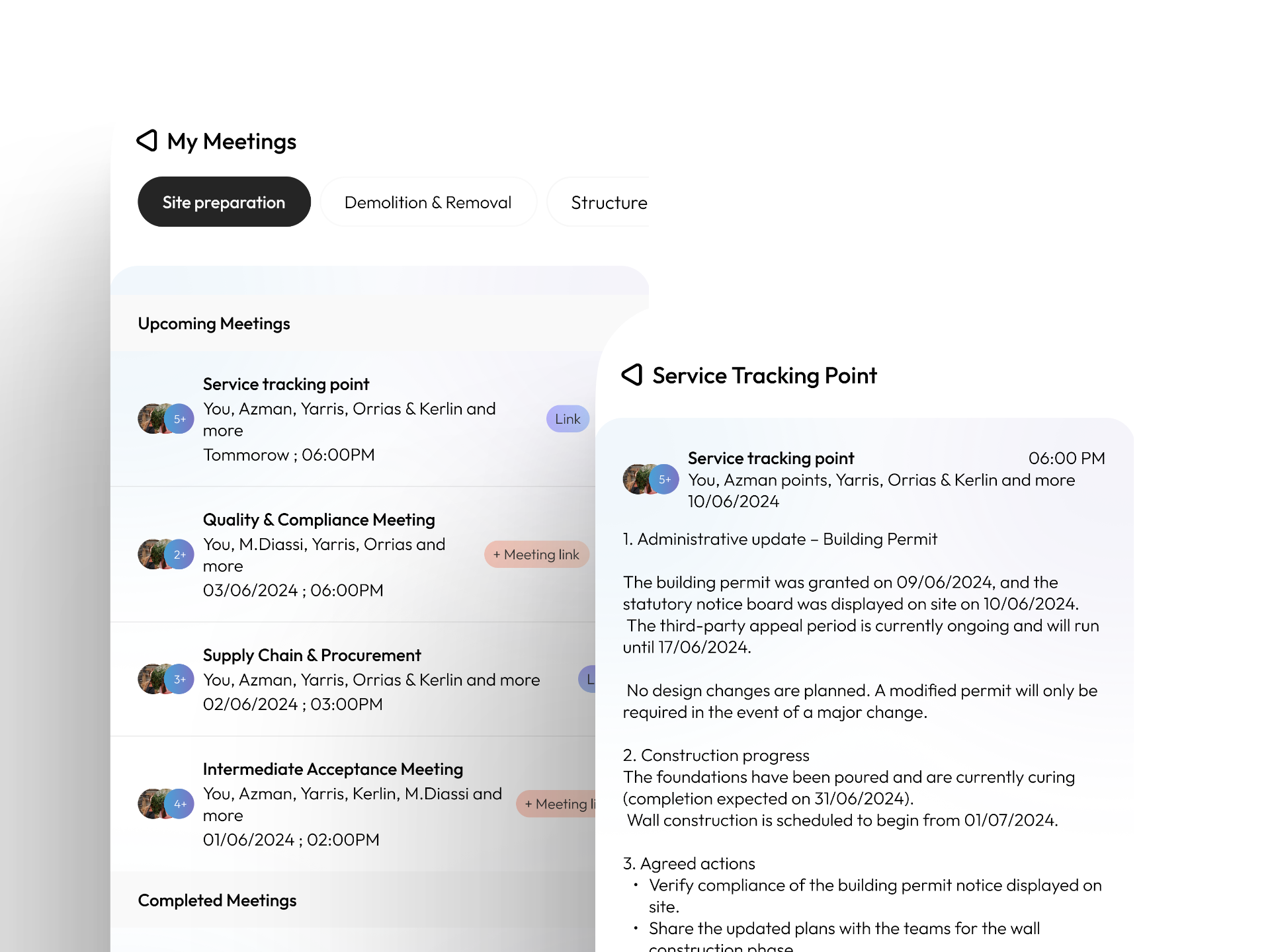
With PIYA, meeting minutes, decisions and exchanges stay attached to the relevant project so every stakeholder can access the same information.
The five ingredients of an effective construction meeting
1. Start by framing the meeting
An effective meeting begins before participants even sit around the table.
Before sending the invitation, several simple questions should be answered:
- Why is this meeting being organized?
- Which decisions need to be made?
- Which topics are intentionally out of scope?
- Who really needs to attend?
- What outcome is expected when the meeting ends?
This framing prevents discussions from drifting away from the main objective and helps every participant arrive prepared.
A meeting without a clear objective quickly becomes a discussion.
2. Prepare information before the meeting
A meeting should never be used to search for documents.
Drawings, photos, estimates, previous meeting minutes and technical documents should be available before the discussion starts.
Participants can then spend their time making decisions rather than looking for information.
3. Turn every decision into an action
Every decision made during a meeting should answer three questions:
- Who is responsible?
- What action needs to be completed?
- By what deadline?
Without these three elements, a decision often remains theoretical.
4. Share meeting minutes quickly
The faster meeting minutes are shared, the more reliable the information remains.
Waiting several days increases the risk of forgetting important points or leaving room for different interpretations.
Meeting minutes should allow every participant to find the decisions made, responsibilities assigned and next steps.
5. Start the next meeting by reviewing previous actions
A meeting should never start from scratch.
Before discussing new topics, it is useful to check whether the actions decided during the previous meeting have actually been completed.
This simple habit creates continuity in project management.
What if your meetings directly fed project tracking?
In many companies, meeting minutes quickly become isolated documents.
They are sent by email, stored in a shared folder, sometimes printed, then gradually forgotten.
PIYA follows a different logic.
Meetings remain directly attached to the project.
Meeting minutes are connected to the relevant stages, documents, photos, participants and project progress.
Decisions therefore remain accessible in their context several weeks or months later.
Instead of searching for an old PDF, teams naturally find the information by consulting the relevant project.
Keep track of every decision made on your projects
Each decision, meeting minute and action remains attached to the right project and accessible to the stakeholders concerned.
You can quickly retrieve the history of discussions without browsing emails or multiple folders.
Conclusion
A construction meeting is never an end in itself.
Its real value does not lie in the discussion, but in the decisions that are actually applied on site.
When a company prepares its meetings, documents its decisions, clearly assigns responsibilities and regularly follows up on actions, meetings stop being simple progress updates.
They become real project management tools.
In the end, a good meeting may not be measured by its duration.
It is mostly measured by everything that happens after it.
FAQ
Frequently Asked Questions
Why are construction meetings often inefficient?
They become inefficient when they are not properly framed, when decisions are not turned into concrete actions, or when responsibilities and deadlines are not clearly defined.
How do you prepare an effective construction meeting?
Define the objective, expected decisions, documents to prepare, required participants and expected outcomes before the meeting starts.
What should construction meeting minutes include?
They should include decisions made, actions to complete, responsible people, deadlines, blockers and next steps.
Why should every action have an owner?
Assigning an owner avoids ambiguity and makes it clear who is responsible for completing each action.
How does PIYA make construction meetings easier to follow?
PIYA keeps meetings, minutes and decisions attached to the project so the whole team can easily retrieve the history of discussions.